nice cannes marathon route
Nice-Cannes Marathon 2026 route, section by section
The 2026 Nice-Cannes Marathon, from the Promenade des Anglais to the Croisette: the wave start, the route section by section (42.195 km, 100 m of climbing), the cut-off times.

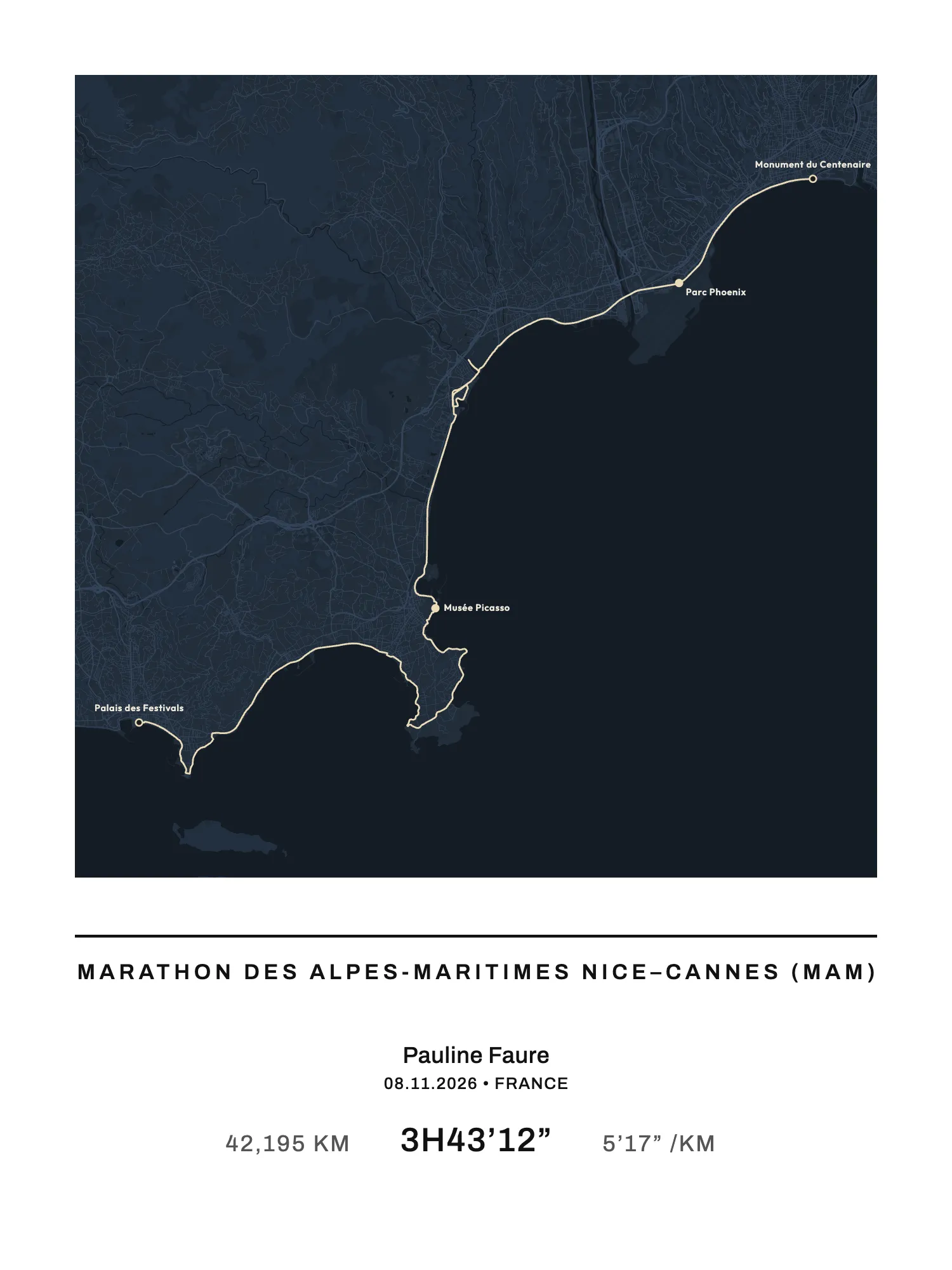
Sunday 8 November 2026, the Promenade des Anglais, in Nice. The 18th Marathon des Alpes-Maritimes Nice-Cannes starts opposite the Théâtre de Verdure and finishes on the Croisette, in Cannes, 42.195 km later. The route crosses seven towns, almost always facing the sea: Nice, Saint-Laurent-du-Var, Cagnes-sur-Mer, Villeneuve-Loubet, Antibes Juan-les-Pins, Vallauris Golfe-Juan and Cannes. The organiser gives 100 m of cumulative climbing and a 6-hour time limit. In 2025, nearly 22,000 runners were on the start line, across all the races; in 2026, the marathon is sold out.
What changes in 2026
The wave start. This is the change the organiser puts first: for this 18th edition, "the start evolves", says the marathon guide, "to ensure smoother starts". The rules set five starts by target time:
| Time | Runners |
|---|---|
| 7:57 am | Wheelchair and para runners |
| 8:00 am | Elites, preferential (under 3 h), 3 h, 3 h 15 |
| 8:25 am | 3 h 30 and 3 h 45 |
| 8:50 am | 4 h and 4 h 15 |
| 9:15 am | 4 h 30, 5 h and over, joëlette teams |
Your start time depends on the pen you chose when you entered. The marathon guide also warns of security checks and bag searches before the pens: get there early.
Zero cups. No single-use cups on the course or at the finish. The water stations are plumbed into the drinking water network, and every runner brings their own container: a soft flask, a hydration bladder or a foldable cup. The organiser expects to cut nearly 3 tonnes of plastic this way.
Three assistance zones. To go with the end of cups, your supporters can refuel you themselves in three zones of about fifty metres, just before an official aid station: at km 10 in Cros-de-Cagnes, at km 20 at the Pont de la Brague, and at km 35 in Golfe-Juan.
The route section by section
The kilometres below come from the organiser's 2026 runner's programme and the GPX route it publishes ("subject to change"). Altitudes are read from that route: take them as a rough guide.
Nice: Promenade des Anglais, Parc Phoenix, the airport (km 0 to 6)
The start is on the Promenade des Anglais, opposite the Théâtre de Verdure, a few steps from the Monument du Centenaire. The field runs west along the Baie des Anges, past the Parc Phoenix and Nice-Côte d'Azur airport, at km 5. The first water station is at km 5, with no cups: have your container ready from the start.
Saint-Laurent-du-Var and Cagnes-sur-Mer (km 6 to 12)
The route crosses the Var into Saint-Laurent-du-Var along the seafront road (km 7.5), then into Cagnes-sur-Mer along the Boulevard de la Plage. At km 10, in Cros-de-Cagnes, come the first assistance zone and the first aid station with food. The route then runs past the Cagnes racecourse.
Villeneuve-Loubet and the Marina Baie des Anges (km 12 to 20)
In Villeneuve-Loubet, the route loops through the Marina Baie des Anges, listed as 20th-century architectural heritage, as the town recalls in the runner's programme. Then the seafront road heads on towards Biot. Level with Vaugrenier, the 20 km runners turn back. The marathon carries on to the Pont de la Brague (km 20), the second assistance zone.
Antibes: Fort Carré, the ramparts, the Musée Picasso (km 20 to 24)
Into Antibes below the Fort Carré. At km 21.1, on the Fort Carré beach, the two-person marathon teams hand over. The route then follows the old town along the Promenade des Remparts, above the sea, to the Musée Picasso.
Cap d'Antibes and Juan-les-Pins (km 24 to 33)
The most beautiful section, and the only one that climbs a little. The route goes round the Cap d'Antibes: the Boulevard James-Wyllie (km 25.5), then the Boulevard de la Garoupe (km 27.9), the marathon's high point, only about thirty metres up. Back by the Boulevard du Maréchal-Juin (km 30.8), then Juan-les-Pins and the Promenade du Soleil. From km 25, the water stations come closer: one about every 1.5 km.
Golfe-Juan and the climb towards La Rapide (km 33 to 38)
The Boulevard du Littoral (km 33.7) leads to Golfe-Juan, home of the third assistance zone (km 35), "before the climb towards La Rapide", as the guide puts it. About fifteen metres of climbing on the route, nothing on paper, but it comes at km 36, when the legs are heavy.
Cannes: from the Pointe Croisette to the Palais des Festivals (km 38 to 42.195)
Into Cannes, round the Pointe de la Croisette (the Boulevard Eugène-Gazagnaire at km 40.5), then the home straight along the Boulevard de la Croisette, towards the Palais. The finish is judged on the Croisette, about 300 m from the Palais des Festivals. After the line: the medal, your bag, then the finishers' area on the Esplanade Pantiero, behind the Palais.
Cut-off times and time limit
The time limit is 6 hours. The rules set four cut-offs, at km 10, 21.1, 30 and 35, counted from the moment the last runner crosses the start arch. With the waves, they count from the last wave's start, not from 8 am. The rules also give the pace of a runner finishing just inside 6 hours:
| Point | Race time |
|---|---|
| km 5 | 0:42:51 |
| km 10 | 1:25:43 |
| km 21 | 3:00:00 |
| km 30 | 4:17:09 |
| km 35 | 5:00:00 |
| km 42.195 | 6:00:00 |
That is about 8 min 30 s per kilometre. A runner overtaken at a cut-off by the organiser's vehicles is declared "out of time", and their chip is taken back.
Aid stations
From the 2026 marathon guide:
- Food and drink: km 10, 15, 19.5, 25, 30.5, 35.5 and 38.5.
- Water: km 5, 7.5, 13, 17, 22, 27, 29, 32.5, 34, 37 and 40.
With no cups, you need your own container. If you have none, there are some on sale at the race village, when you collect your bib.
Why it is harder than it looks
On paper, it is a fast marathon: 100 m of climbing, a route measured to FFA and World Athletics standards, and course records of 2:07:25 for men (2018) and 2:28:15 for women (2022). On the ground, three things make it harder.
The seafront. The city of Nice sums it up in the runner's programme: 95% of the route faces the sea. That is the beauty of the race: you run in the open, by the water, almost all the way.
The bumps come late. The Cap d'Antibes, then the climb after Golfe-Juan, fall between km 25 and km 37. Small hills, but in the last third, where a marathon is won or lost.
It is one way, so plan it. Start in Nice, finish in Cannes. Your bag is dropped on the Place Masséna, in Nice, and collected in Cannes. To get back, your bib is your ticket on the ZOU! trains between Nice and Cannes all day on 8 November.
A little history
The first edition was in 2008. According to the organiser, the race has had nearly 210,000 entrants since, from nearly 90 countries, and calls itself the biggest marathon in France after Paris. In 2025, nearly 30% of the runners on the start line came from abroad, and nearly half were running their first marathon.
Keep the route
The Nice-Cannes is a line that follows the coast from end to end, which is why it sits so well on a map.
On Map My Life, the Nice-Cannes Marathon draws the whole coast from the Baie des Anges to the Croisette, with the Monument du Centenaire, the Parc Phoenix, the Musée Picasso and the Palais des Festivals named on the route. You add your name, your time and your pace.
The A4 PDF is free. A print costs €40 in A4, €50 in 30 × 40 cm and €60 in 50 × 70 cm; framed, €75 in A4 and €85 in 30 × 40 cm. Delivery €4.90 for prints, €7.90 with a frame, once per order, to the whole European Union, Monaco, Switzerland, Norway, Iceland, the United Kingdom, the United States, Canada, Australia, New Zealand, Japan, Singapore, La Réunion, Guadeloupe and Martinique.FAQ
What time does the 2026 Nice-Cannes Marathon start?
On Sunday 8 November 2026, in five waves: 7:57 am for wheelchair and para runners, then 8:00, 8:25, 8:50 and 9:15 am by target time. The start is on the Promenade des Anglais, opposite the Théâtre de Verdure.
How much climbing is there on the Nice-Cannes Marathon?
100 m of cumulative climbing, according to the organiser. The high point is on the Cap d'Antibes, at about thirty metres.
What is the time limit of the Nice-Cannes Marathon?
6 hours, with cut-offs at km 10, 21.1, 30 and 35, counted from the moment the last runner crosses the start arch.
Do I need to bring a cup?
Yes. In 2026, no cups are handed out, on the course or at the finish. Bring a flask, a bladder or a reusable cup.
How do I get back to Nice after the finish?
Your bib gets you on the ZOU! trains between Nice and Cannes, both ways, all day on 8 November. Runners who booked it also have a shuttle bus, from the port of Cannes.
How many runners start?
Nearly 22,000 in 2025, across all the races, according to the organiser. The marathon is sold out in 2026.