gps watch marathon 42.7 km
Why your GPS watch says 42.7 km after a marathon
Your GPS watch says 42.7 km, the marathon is 42.195. The course is measured on the shortest line, 30 cm from the edge in corners. What it costs you, and how to set your pace.
 Alexandre · Founder of Map My Life
You cross the line, stop your GPS watch: 42.7 km. The marathon is 42.195 km, 26.2 miles on paper, often 26.5 on the watch. Your watch isn't necessarily wrong, and neither is the organiser. The official course and the course you ran are not the same line: here is where those 500 metres come from, and why they matter when you set your pace.
The marathon is measured on the shortest line
A road race course is not measured down the middle of the road. The World Athletics/AIMS course measurement manual, which certified courses follow, defines the course as the shortest route a runner could take without being disqualified. The measurer imagines a taut string between start and finish, hugging the inside of every corner, 30 cm from the edge of the road (or the barriers), whatever the angle.
They ride that route on a calibrated bicycle, then add a margin: the "short course prevention factor", 1 metre per kilometre. It is there so the course isn't short, even with the bicycle's measuring error. Over a marathon, that's about 42 metres more on the measured line: about 42.237 km.
Nobody runs that taut string. Every metre you run off it adds up.
Every corner adds a few metres
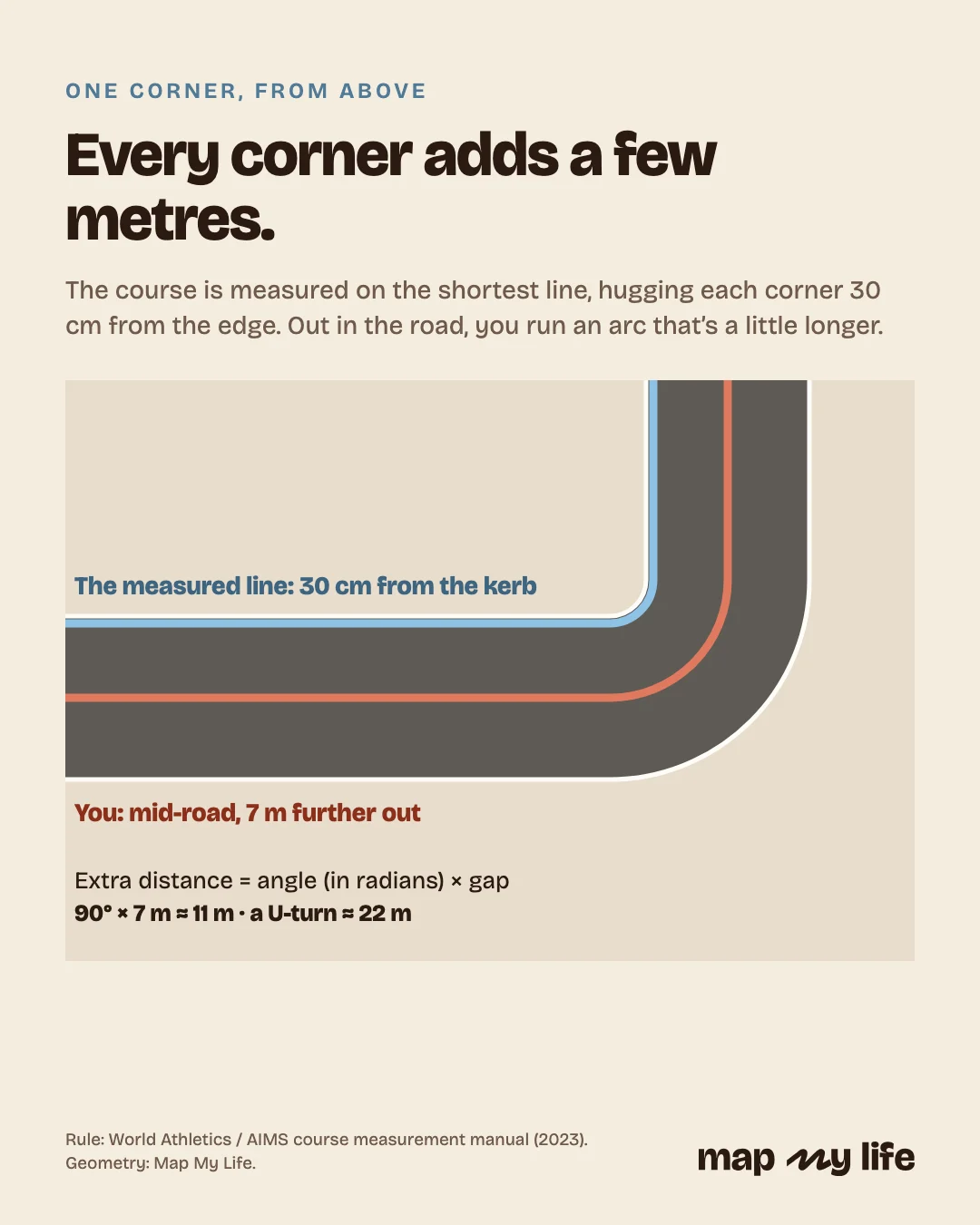
In a corner, the extra distance is simple to work out: the corner's angle, in radians, times your gap from the measured line, the tangent. A right angle is 1.57 radians.
| Corner | 3 m off the tangent | 7 m off (middle of a 15 m avenue) |
|---|---|---|
| 45° | 2.4 m | 5.5 m |
| 90° | 5 m | 11 m |
| U-turn (180°) | 9 m | 22 m |
One corner is almost nothing. A city marathon has dozens.
On the Paris course: about 50 metres per metre off the tangent
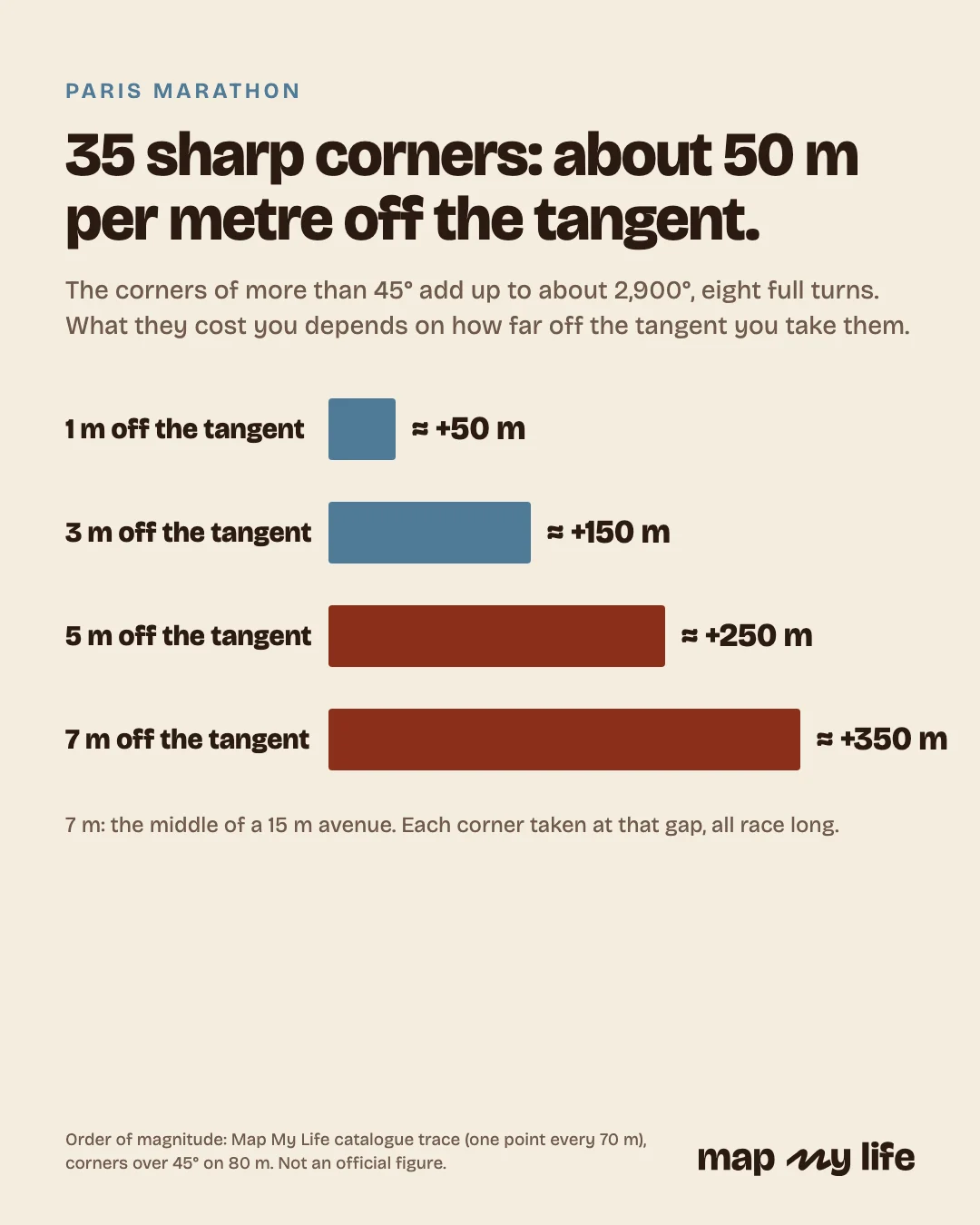
We counted the corners of more than 45° on the Paris Marathon trace: 35, from the Champs-Élysées to avenue Foch, by way of Bastille, the Bois de Vincennes, the Seine embankments and the Bois de Boulogne. Together they turn about 2,900°, eight full turns.
Hence a simple rule: every metre you leave between you and the tangent, in each of these corners, costs you about 50 metres over the race. At 3 m off the tangent, about 150 m more. In the middle of a 15 m avenue, 7 m off, about 350 m. Gentle bends and winding streets add a little more.
It's an order of magnitude, not an official measurement. Our trace has a point about every 70 m; we removed three short back-and-forths that were errors. Two corners less than 70 m apart can slip through: the real figure is probably a little higher.
And the rest: aid stations, overtaking, GPS
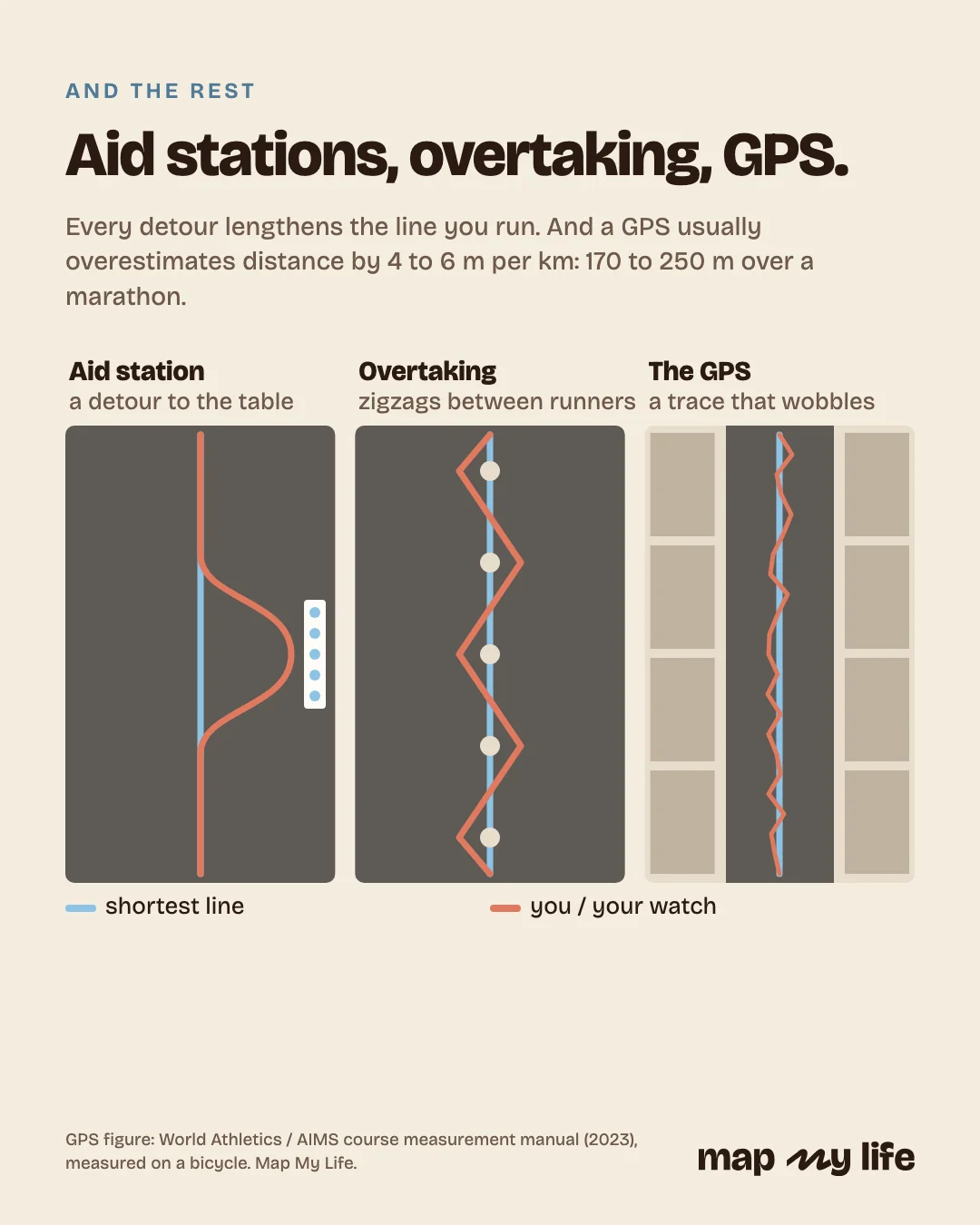
Corners don't explain everything. There are also:
- aid stations: you drift over to the tables, then back;
- overtaking and crowds: in a dense field, you weave more than you think;
- your watch's GPS: it estimates your position to within a few metres, at regular intervals, and joins the dots. The measurement manual notes that a GPS, even mounted on a bicycle, usually overestimates distance by 4 to 6 metres per kilometre: 170 to 250 m over a marathon. Between tall buildings, under trees or in a tunnel, the error grows.
Put together, it adds up: 42 m of margin, about 150 m of corners taken 3 m off the tangent, about 200 m of GPS, and the rest in aid stations and overtaking. Your 42.7 km is nothing unusual. To see where you took your corners wide, export your track (Garmin, Coros, Suunto) and look at it closely.
What it changes for your pace
This is where those 500 metres matter. Your watch works out your pace on its own distance, the results on 42.195 km. To finish in 4 hours, you need to hold 5:41 per km over 42.195 km. If you hold exactly that pace on your watch and it counts 42.7 km at the finish, your pace over the official 42.195 km is 5:45. Result: 4:02:52. Target missed by almost 3 minutes, without slowing down.
| Target | Official pace | Hold that pace on the watch (42.7 km), you finish in | Watch pace to aim for |
|---|---|---|---|
| 3:30 | 4:59 /km | 3:32:31 | 4:55 /km |
| 4:00 | 5:41 /km | 4:02:52 | 5:37 /km |
| 4:30 | 6:24 /km | 4:33:14 | 6:19 /km |
The times assume the target's exact pace, held all race. For reference: at the 2026 Paris Marathon, half the finishers took more than 4:08 (see France's marathons in 2026).
Two habits:
- Aim for a watch pace slightly faster than your target pace: about 4 seconds per km for a 4-hour target.
- Trust the kilometre markers rather than your watch's distance. Turn off auto-lap and press "lap" at each marker: you'll see your time per official kilometre, the one that counts for your result.
How to run less distance
- Run the tangents. In every corner, move towards the inside edge, without cutting anything the course markings forbid.
- Set up the next corner. Between two corners in opposite directions, the shortest line crosses the road diagonally. Crossing costs almost nothing: according to the manual, crossing a 10 m wide road over 100 m adds 50 cm. Switching sides at the last moment, though, means taking the corner far from the tangent.
- Take water without detours. Pick a table on the side you're running on, rather than crossing over.
Your marathon as a poster
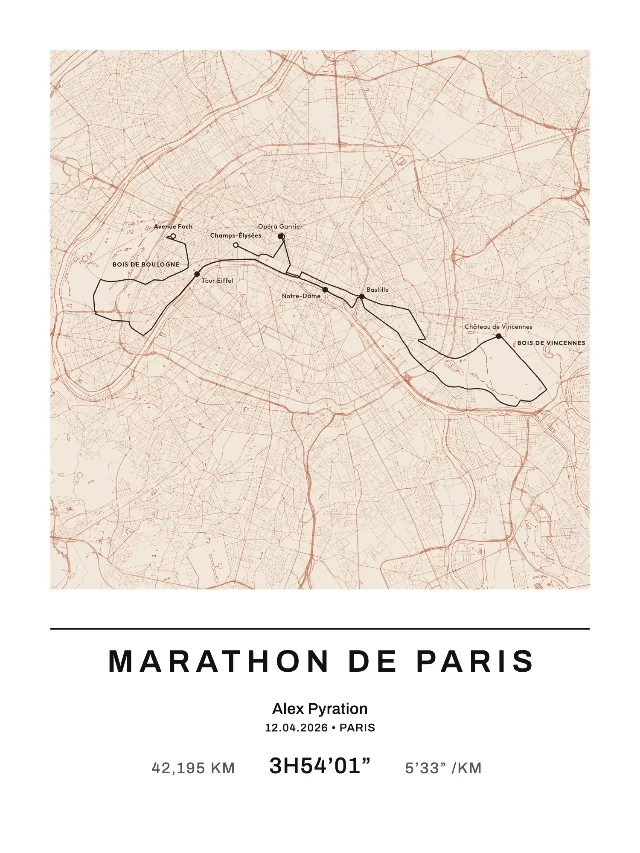
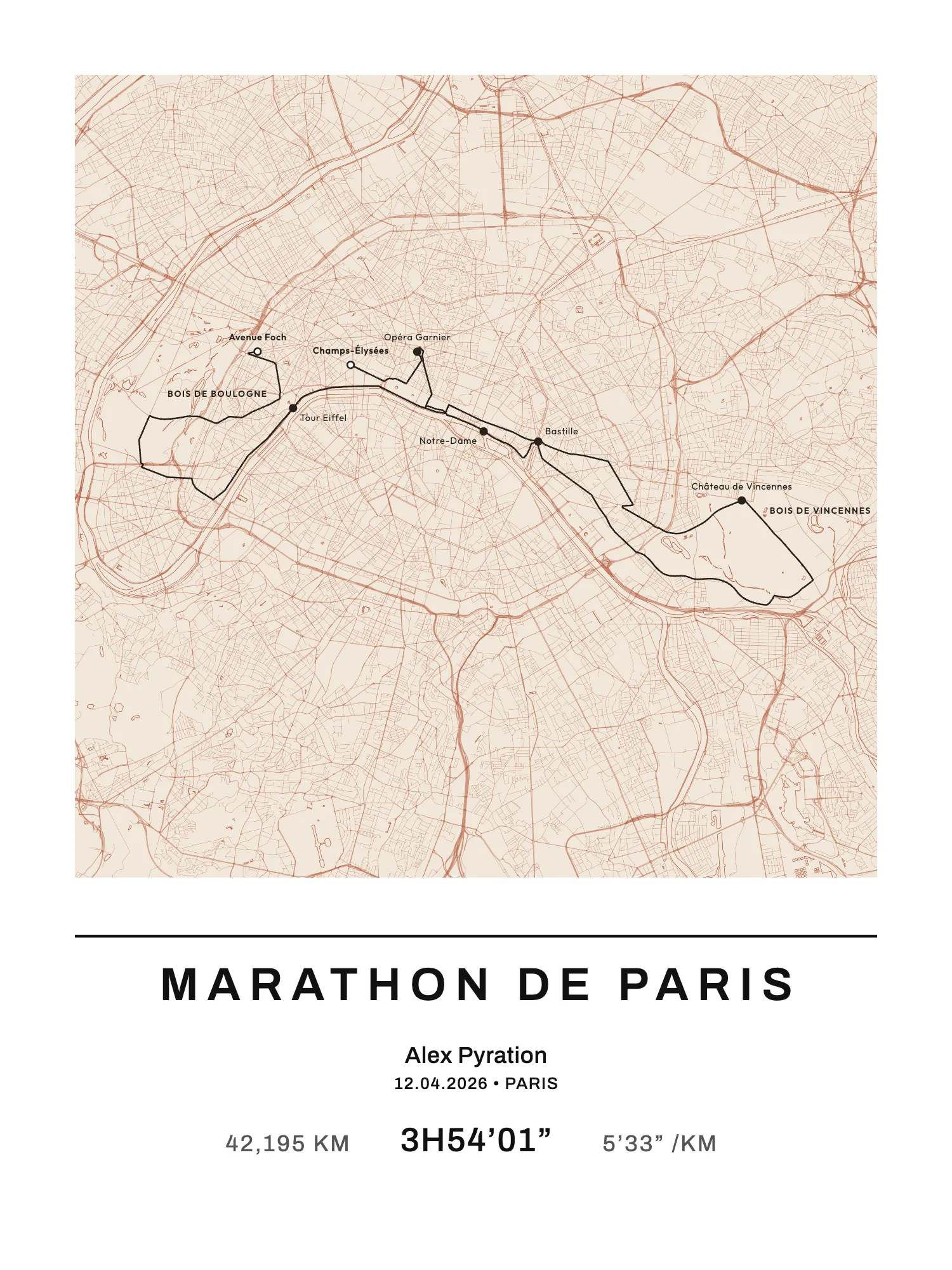
On your poster, it's the official course that counts, the 42.195 km one: the race as it was measured, with your name and your time. The pace printed on it is worked out on 42.195 km, not on your watch. The Paris Marathon poster draws the course in full, from the Champs-Élysées to avenue Foch.
A print costs €40 in A4, €50 in 30 × 40 cm and €60 in 50 × 70 cm; framed, €75 in A4 and €85 in 30 × 40 cm. The digital version, sent by e-mail, costs €5 at any size. Delivery €4.90 for posters, €7.90 with a frame, once per order, to the whole European Union, Monaco, Switzerland, Norway, Iceland, the United Kingdom, the United States, Canada, Australia, New Zealand, Japan, Singapore, La Réunion, Guadeloupe and Martinique.Method
The rules and the GPS figure come from the World Athletics/AIMS manual "The Measurement of Road Race Courses", 2023 edition (we read the French one). Corner distances are geometry: the arc of a circle whose radius grows by your gap. The Paris corners are counted on the Map My Life catalogue trace, resampled every 5 m: a corner is a change of direction of more than 45° over 80 m. The times in the pace table assume a pace held steady all race by the watch, and a watch that counts 42.7 km.
FAQ
Why does my watch show more than 42.195 km in a marathon?
Because the course is measured on the shortest possible line, 30 cm from the edge in corners, and nobody runs exactly that line. Add aid stations, overtaking and GPS, which usually overestimates distance by 4 to 6 m per km. A few hundred metres extra on the watch is normal in a city marathon.
Is a marathon really 42.195 km?
At least 42.195 km, yes, on the shortest possible line. The measurer adds 1 metre per kilometre so the course isn't short: about 42.237 km on the measured line.
How many metres does a badly taken corner cost?
The corner's angle in radians times your gap from the tangent. A 90° corner taken 7 m wide costs about 11 m, a U-turn 22 m. On the Paris Marathon, about 50 m per metre of gap, across all the sharp corners.
Should I trust my watch's pace in a marathon?
Not entirely. If your watch counts 42.7 km, the pace it shows is about 1% faster than your official pace: 4 seconds per km for a 4-hour target. Aim a little faster than your target pace, or take your splits at the kilometre markers.
Is my result wrong?
No. Your time, measured by your chip, covers a course of at least 42.195 km: it's right. What differs is the pace: your watch works it out on its own distance, the results on 42.195 km.