diagonale des fous route· updated
Diagonale des Fous 2026 route, section by section
The 2026 Diagonale des Fous, from Saint-Pierre to Saint-Denis: the results, then the route section by section (180 km, 10,200 m of climbing, Salazie instead of Cilaos) and the cut-off times.

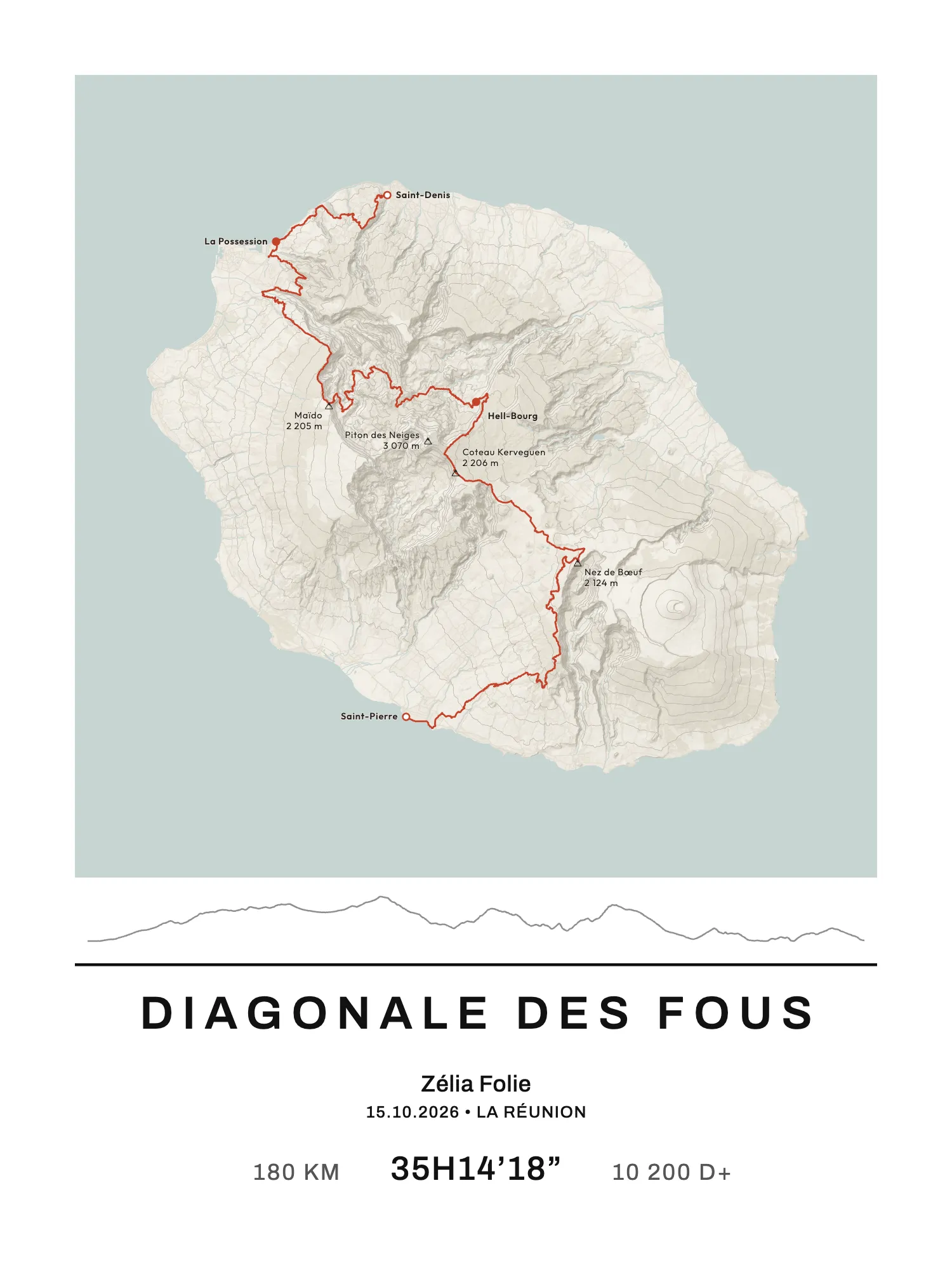
Thursday 15 October 2026, 10 pm, Ravine Blanche, in Saint-Pierre. Nearly 2,800 runners set off across Réunion for 180 km and 10,200 m of elevation gain (D+, the total climbing), with 66 hours at most to reach the Stade de la Redoute, in Saint-Denis. The Diagonale des Fous route changed a lot in 2026: it no longer goes through Cilaos. It climbs via the volcano, drops into the Cirque de Salazie at Hell-Bourg, then crosses Mafate before climbing back up to the Maïdo.
The 2026 Diagonale: results
Hugo Deck won the 34th Diagonale des Fous in 22 h 54 min 19 s, at his first attempt. Robin Juillaguet, also new to the race, finished second, 57 minutes back, and Belgium’s Jérôme Vanderschaeghe third. In the women’s race, New Zealand’s Ruth Croft also won at her first Diagonale, in 27 h 13 min 23 s, eleventh overall.
| Place | Men | Time | Women | Time |
|---|---|---|---|---|
| 1 | Hugo Deck (France) | 22 h 54 min 19 s | Ruth Croft (New Zealand) | 27 h 13 min 23 s |
| 2 | Robin Juillaguet (France) | 23 h 51 min 54 s | Alyssa Clark (United States) | 28 h 26 min 53 s |
| 3 | Jérôme Vanderschaeghe (Belgium) | 24 h 10 min 35 s | Agathe Bes (France) | 29 h 05 min 19 s |
Behind them, a little over 2,100 runners reached the Redoute: 2,126 finishers out of 2,767 starters according to the first published counts, a drop-out rate of about 23%. These figures stay provisional until the organisers publish their own. The full results are on the Grand Raid website.
Here’s the 2026 route section by section, with the published distances and cut-off times.
What changes in 2026
For years, the section through Cilaos, the Col du Taïbit and Marla was part of the race’s identity. For 2026, the organisers have taken it out. According to Réunion la 1ère, the reason is that the cirque has been saturated for several years, with safety concerns as a result. So the Col du Taïbit, Marla, the Plaine des Tamarins and the Col de la Fourche all disappear from the route.
Instead, runners reach Salazie via the Coteau Kerveguen, Cap Anglais and the Bélouve gîte, down to Hell-Bourg. They then enter Mafate via the Plaine des Merles.
The figures move too: 180 km instead of 175, and 10,200 m of D+ instead of 10,500. Longer, a little less climbing, but no easier for it. The descent from the Coteau Kerveguen to Hell-Bourg is among the most technical on the island.
Cilaos hasn’t disappeared from the Grand Raid: it’s the start of the Trail de Bourbon (106 km, 6,200 m D+ in 2026).
The route section by section
The kilometres below are those of the checkpoints in the 2026 rules. The climbing per section is an estimate worked out from the trace: take it as an order of magnitude, not an official figure.
Saint-Pierre → Domaine Vidot (km 0 to 14)
A start on the coast, at night, in the noise. The first kilometres climb gently through the sugar cane and the upper districts of Saint-Pierre, about 670 m of D+. The first aid station, at Domaine Vidot (km 13.9), closes at 1.30 am, three and a half hours after the start. The trap here isn’t the slope but the crowd: you shuffle, you get impatient, you go off too fast.
Domaine Vidot → Notre-Dame-de-la-Paix (km 14 to 33)
The real climb begins: nearly 1,500 m of D+ over twenty-odd kilometres, still at night. Cut-off at Notre-Dame-de-la-Paix (km 33.3) at 7 am, on Friday morning.
Notre-Dame-de-la-Paix → Nez de Bœuf → Mare à Boue (km 33 to 56)
You pass 2,000 m of altitude around the Nez de Bœuf (km 45.4, cut-off at 10.30 am), on the edge of the Rivière des Remparts. Then you cross the Plaine-des-Cafres to Mare à Boue (km 55.6, cut-off at 1 pm). This is the most runnable part of the race, and the coolest: at daybreak it can be cold on these plateaus.
Mare à Boue → Coteau Kerveguen → Hell-Bourg (km 56 to 80)
The heart of the new route. About 1,000 m of climbing to the Coteau Kerveguen (checkpoint at 5.30 pm, km 67.6), then Cap Anglais and a long technical descent to the Bélouve gîte (km 76.4, cut-off 8.30 pm) and Hell-Bourg (km 80.4). On this stretch you lose about 1,600 m. Your quads will remember it all the way to Saint-Denis.
Hell-Bourg closes at 1 am, on Saturday. It’s one of the race’s “villages”: you meet your support crew there, you sit down, and some never leave.
Hell-Bourg → Plaine des Merles → Grand Place (km 80 to 108)
A climb of more than 1,200 m to the Plaine des Merles (km 93.6, cut-off at 6 am), then the Sentier Scout and the descent into Mafate. Mafate has no road: everything that reaches the aid stations gets there on foot or by helicopter. Îlet à Bourse, then Grand Place École (km 107.6), cut-off at 11.30 am.
Grand Place → Roche Plate → Maïdo (km 108 to 124)
The section everyone dreads. More than 2,100 m of D+ in 16 km, via Roche Plate (checkpoint at 4.30 pm) then the wall of the Maïdo, on the second day of the race, often in the full heat. The Maïdo viewpoint (km 123.7) closes at 8.30 pm on Saturday. From there you see the whole of Mafate from above, and you finally understand where you’ve come from.
Maïdo → Îlet Savannah → La Possession (km 124 to 155)
Almost 1,900 m of descent to Îlet Savannah (km 140.3, cut-off at 12.15 am on Sunday), including the Chemin Ratinaud (km 147.7, 3 am). The feet suffer more than the heart. You reach La Possession, at the festival square, at km 154.9 (cut-off 6.30 am).
La Possession → Grande Chaloupe → Colorado → Saint-Denis (km 155 to 180)
The last hard part: the Chemin des Anglais, an old basalt-paved path between La Possession and the Grande Chaloupe (km 164.3, cut-off 9 am), then the climb back up to the Colorado (km 173.6, 1.30 pm), above Saint-Denis. From there, a few kilometres of descent remain to the Redoute. Finish by 4 pm on Sunday 18 October at the latest.
The cut-off times at a glance
| Point | km | Closes |
|---|---|---|
| Domaine Vidot | 13.9 | Fri 1.30 am |
| Notre-Dame-de-la-Paix | 33.3 | Fri 7 am |
| Nez de Bœuf | 45.4 | Fri 10.30 am |
| Mare à Boue | 55.6 | Fri 1 pm |
| Gîte de Bélouve | 76.4 | Fri 8.30 pm |
| Hell-Bourg | 80.4 | Sat 1 am |
| Plaine des Merles | 93.6 | Sat 6 am |
| Grand Place École | 107.6 | Sat 11.30 am |
| Maïdo | 123.7 | Sat 8.30 pm |
| Îlet Savannah | 140.3 | Sun 12.15 am |
| La Possession | 154.9 | Sun 6.30 am |
| Grande Chaloupe | 164.3 | Sun 9 am |
| Colorado | 173.6 | Sun 1.30 pm |
| Saint-Denis, the Redoute | 180 | Sun 4 pm |
Réunion local time (two hours ahead of mainland France in October). These are the 2026 rules’ cut-offs: the next edition’s will come with its own rules.
Why it’s so hard
The figures don’t tell the whole story. On paper, 180 km and 10,200 m is close to the UTMB. On the ground, the comparison soon ends.
The ground. Roots, basalt slabs, cut steps, ladders, riverbeds. You run little, walk a lot, and your average speed collapses on the descents, exactly where you gain time elsewhere.
The heat and the humidity. You go from the tropical coast to the cold plateaus of the volcano, then to stifling cirque floors. You need a warm layer and a hooded waterproof jacket in your pack, and yet you often finish dehydrated.
Two nights, sometimes three. With a 10 pm start, you begin the race already tired, and many runners spend two nights out. Sleep becomes a tactical decision.
Mafate. Once you’re in, dropping out doesn’t mean going home. You have to get back out, on foot or by helicopter.
A little history
The first edition took place in 1989 as the “Marche des Cimes”: about 112 km, from the Barachois in Saint-Denis to Le Tremblet, in Saint-Philippe, with some 550 entrants. The race was then called the “Grande Traversée”, then the “Course de la Pleine Lune”, before becoming the Grand Raid in 1994. The nickname Diagonale des Fous, the “madmen’s diagonal”, comes from there: crossing the island diagonally, over a distance and a climb that seemed unreasonable.
The direction of the race has changed over the years. Today it starts in the south, at Saint-Pierre, and finishes in the north, at Saint-Denis. And you have to earn your place: in 2026 the entry cost €260 and the 3,000 places went very quickly.
Keeping the route
A Diagonale is more than a time. It’s a line across a whole island, from south to north, and that’s why it suits a map so well.
On Map My Life, the Diagonale des Fous frames the whole of Réunion, not just the route: you see the island, the cirques, the volcano. You add your name, your time, the year. If you ran it before 2026, when it went through Cilaos, tick The route was different when you choose your year: we find the right route and ask you to approve it before printing.
The A4 PDF is free. A print costs €40 in A4, €50 in 30 × 40 cm and €60 in 50 × 70 cm; framed, €75 in A4 and €85 in 30 × 40 cm. Delivery €4.90 for prints, €7.90 with a frame, once per order, to the whole European Union, Monaco, Switzerland, Norway, Iceland, the United Kingdom, the United States, Canada, Australia, New Zealand, Japan, Singapore, La Réunion, Guadeloupe and Martinique. Live on Réunion? Write to us at contact@mapmylife.fr before ordering and we’ll look at delivery with you.
Ran another legendary race? The UTMB and the Ultra-Trail di Corsica are in the catalogue too.
FAQ
Who won the 2026 Diagonale des Fous?
Hugo Deck, in 22 h 54 min 19 s, ahead of Robin Juillaguet and Jérôme Vanderschaeghe. In the women’s race, Ruth Croft won in 27 h 13 min 23 s, ahead of Alyssa Clark and Agathe Bes.
When did the 2026 Diagonale des Fous start?
On Thursday 15 October 2026 at 10 pm, Réunion time, from Ravine Blanche in Saint-Pierre. Runners had until 4 pm on Sunday 18 October to reach Saint-Denis.
How long is the Diagonale des Fous, and how much climbing does it have?
180 km and 10,200 m of elevation gain in 2026, according to the organisers. It was 175 km and 10,500 m in 2025, before the route changed.
Did the Diagonale des Fous go through Cilaos in 2026?
No. The section through Cilaos, the Taïbit and Marla was dropped in 2026. The race goes through Salazie (Bélouve, Hell-Bourg) before entering Mafate via the Plaine des Merles.
What is the time limit?
66 hours, with intermediate cut-offs at every aid station. The most feared is often the one at the Maïdo, after the climb from Roche Plate.